British Museum
- History enthusiasts
- Archaeology enthusiasts
- Families with children
Upcoming Tours

What Visitors Say


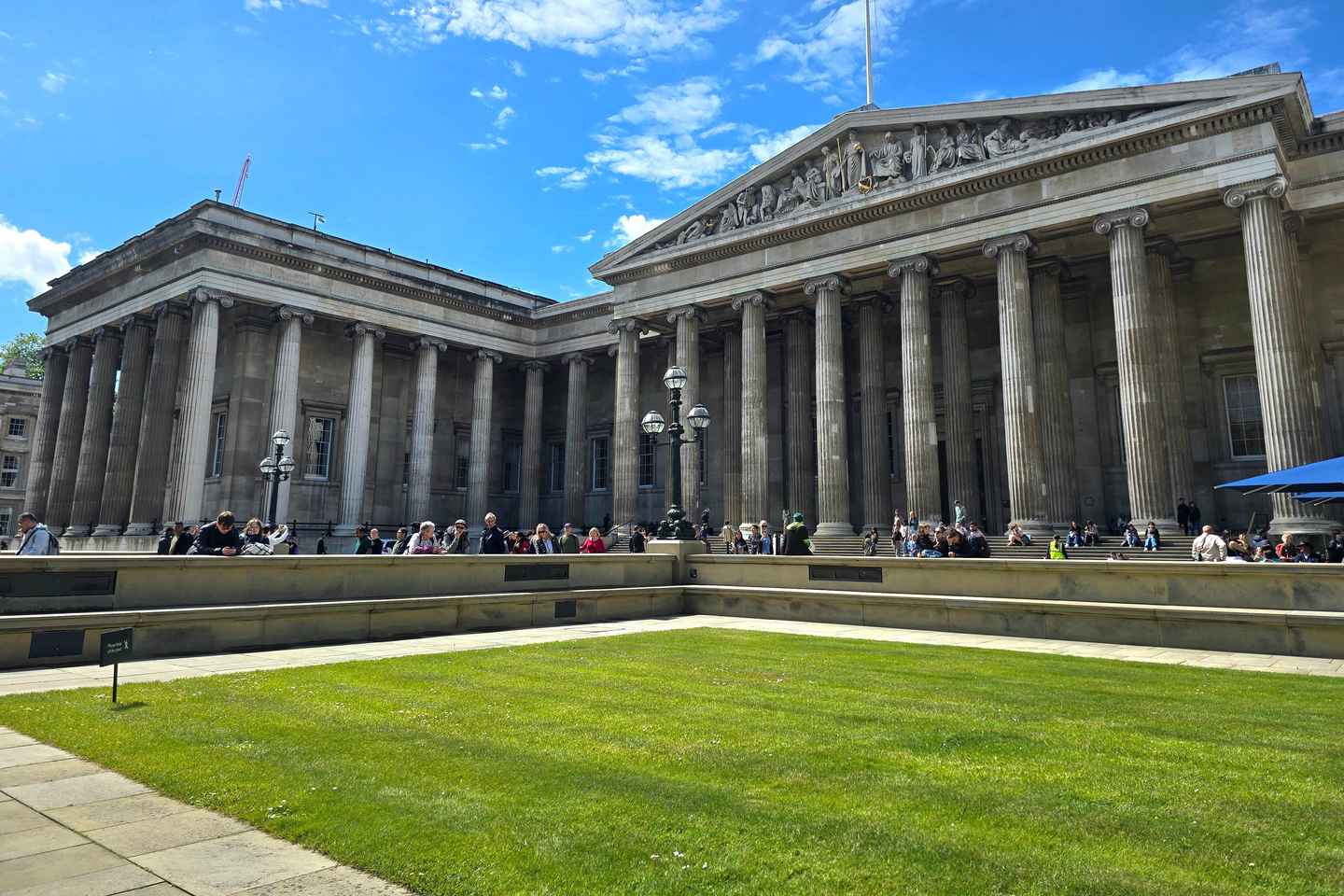
A world-class museum that you cannot miss! The British Museum holds an unbelievable collection of human history from all over the globe. The Great Court's stunning glass roof is a spectacular sight as soon as you walk in. Seeing the Rosetta Stone, the Parthenon sculptures, and the Egyptian mummies up close was a fascinating experience. You could easily spend an entire day here and still not see everything. Recommended and a must visit. PS: There is no AC in the Museum so it can be very hot inside :) And take a picture of the Museum map so that you can direct yourself :)

A must visit ! I only wish I had more time to come again. The souvenirs are so premium ! Entrance is free but it’s better to have your ticket booked in advance to avoid the wait especially during summertime. I was so relieved that I did not have to wait under the heat.

If you try to ignore all the colonial history, it’s quite a good day out. There’s loads to see and even the building itself is impressive. There’s cafes inside and an extensive gift shop. The staff are friendly. Downsides for me were that I went here during a heatwave hoping it’d have AC but only like 3 rooms did so it was still hot inside, and that all the glass in front of the objects made it impossible to photograph most things, like the Rosetta Stone.

This is one of the great museums that I have visited. I was surprised because it free and there are a lot of Galleries from around the world. Highly recommend for everyone come and see it. Dont forget to get Museum map in reception desk. There also has a restaurant in second floor.

One of the great museums of the world, but also one of the most popular, so expect crowds, particularly in the Egyptian and Greece sections. Entry is free, but an online booking is recommended, though doesn't appear to be checked when you arrive. There can be queues to get through security. The temporary exhibitions can also be popular and have entry fees, so buy your ticket well in advance. Strongly recommend arriving at the start or end of the day, and avoid weekends if possible, to get the best visitor experience. The Japanese and African galleries tend to be quieter, as they're a little out of the way, with the Japanese on level 5 at the north end of the building, and African in the basement. The collection is incredible but the visitor experience can be overwhelming, due to the number of items on display, and the number of people visiting. The British Museum is a must visit but manage your expectations.
Highlights
Rosetta Stone
Key to decoding Egyptian hieroglyphsCarved in 196 BC and rediscovered in 1799, its Greek, Demotic and hieroglyphic texts let Champollion crack the code of ancient Egypt in 1822, giving voice to a lost script.
Room 4, Ground Floor
Parthenon Sculptures
Masterpieces from Athens’ AcropolisCreated around 447-432 BC, these marble carvings once wrapped the Parthenon temple, showing ritual processions and mythic battles that set gods and mortals side by side.
Room 18, Ground Floor
Egyptian Mummies
Burials spanning 3,000 yearsMore than 120 mummies and coffins, from c.3000 BC to Roman Egypt, chart changing beliefs, resins and wrappings used to prepare the dead for an eternal afterlife.
Rooms 62-63, Upper Floor
Lewis Chessmen
12th-century Norse ivory chess setFound in 1831 on the Isle of Lewis, 93 walrus-ivory pieces-grimacing bishops to shield-biting rooks-reveal medieval humour and seafaring trade across the North Atlantic.
Room 40, Upper Floor
Great Court
Europe’s largest covered public squareOpened in 2000, Norman Foster’s glass roof spans 3,312 uniquely shaped panes over two acres, transforming the 1857 Reading Room courtyard into a bright civic space.
Central Hall, Ground Floor
Opening Hours
Visitor Information
Audio app languages: English, Chinese (Mandarin), Spanish, Italian, French, Korean, Japanese, German, British Sign Language.
Confirmed by British Museum Audio app (checked 12 August 2026).
Fun Facts
Founded in 1753, the museum opened in 1759 on Great Russell Street as one of the world’s first public museums.
The collection holds about 8 million objects-only around 1% can be displayed at once.
In 2023 the museum welcomed about 5.8 million visitors, up roughly 42% on 2022.
The Lewis Chessmen cameo as wizard chess pieces in the 2001 film Harry Potter and the Philosopher’s Stone.
The Great Court’s glass roof covers two acres with 3,312 unique panes, no two exactly alike.
Similar Museums


Nearby Places

Wiener Library
3 min 👣
Brunei Gallery
4 min 👣
Pushkin House
4 min 👣
The Building Centre
4 min 👣
Dominion Theatre
4 min 👣
Gillian Lynne Theatre
7 min 👣
Phoenix Theatre
7 min 👣
The Ship Tavern
7 min 👣
Petrie Museum of Egyptian Archaeology
8 min 👣
Library and Museum of Freemasonry
8 min 👣