Old Royal Naval College
⭐ Highligts
Painted Hall
Britain’s grandest Baroque interiorJames Thornhill spent 19 years (1707–1726) painting a ceiling-and-wall epic celebrating navigation, monarchy, and scientific discovery—think allegory meets star chart.
📍 King William Court (ticketed entry)
Chapel of St Peter & St Paul
A serene Neoclassical counterpointRebuilt after an 18th-century fire, the chapel’s light interior blends crisp columns, an exquisite Coade-stone pulpit and a rippling anchor-motif ceiling for seafarers’ prayers.
📍 Queen Mary Court
River Court & Domes
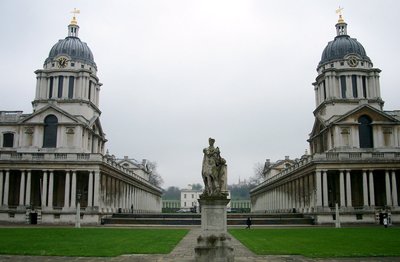
Wren’s axial planning with a viewTwo domes open a view corridor from the river to the Queen’s House and Observatory—the campus is basically a ceremonial telescope pointed at time.
📍 Along the Thames frontage
Skittle Alley
Victorian leisure beneath Baroque grandeurHidden below the chapel is a 19th-century skittle alley used by pensioners of the Royal Hospital for Seamen—conviviality under the stones.
📍 Undercroft, by tour only
Film & TV Spots
A chameleon for cinemaFrom ‘Les Misérables’ barricades to ‘Bridgerton’ balls and Marvel’s Asgard, the courtyards shape-shift with astonishing ease.
📍 Site-wide (check daily map)
Opening Hours
🤓 Fun Facts
Before the Baroque, this was the Tudor Palace of Placentia—birthplace of Henry VIII (1491) and Elizabeth I (1533).
Admiral Nelson lay in state in the Painted Hall for three days in January 1806—over 30,000 mourners filed past.
Thornhill was paid by the square yard for the Painted Hall and later knighted—the first British-born artist to receive a knighthood (1720).
Those crisp sculptural details in the chapel? Many are Coade stone—a near-mythical, frost-proof ‘artificial stone’ perfected in Georgian London.
There really are beehives on site; Greenwich honey from the Naval College’s gardens turns up seasonally in the shop.